
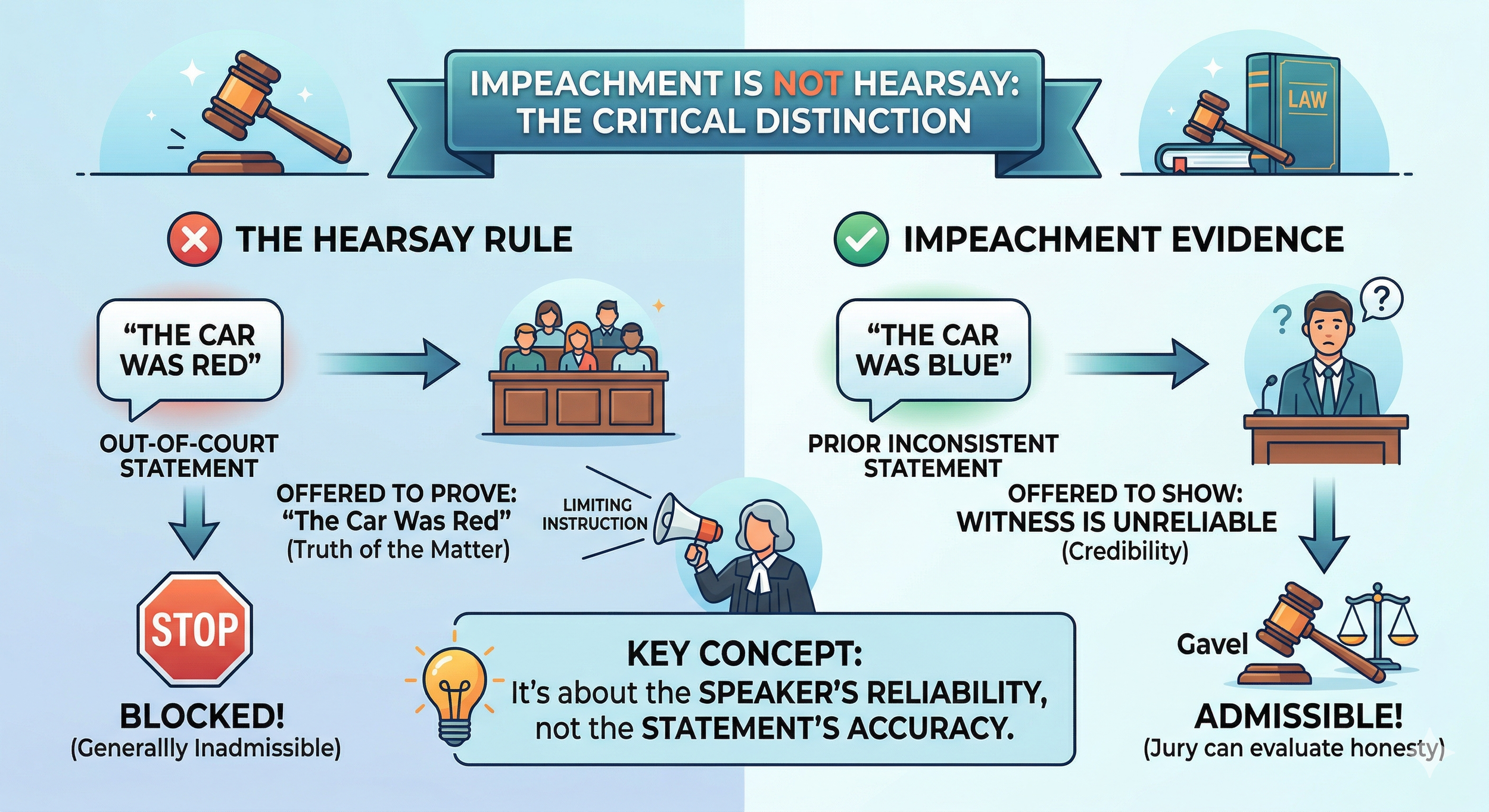
In the realm of evidence law, the distinction between impeachment and substantive evidence is the primary reason why impeachment is not considered hearsay. To understand this, one must look at the legal definition of hearsay and the specific purpose for which impeachment evidence is offered.
The Definition of Hearsay
Under the Oklahoma Rules of Evidence , specifically 12 O.S. 2801, hearsay is defined as an out-of-court statement offered in court to prove the truth of the matter asserted. If a party introduces a statement to prove that the facts within that statement are true, it is hearsay and generally inadmissible unless an exception applies.
The Purpose of Impeachment
Impeachment, however, does not seek to prove the truth of the statement. Instead, its purpose is to attack the credibility of a witness. When a lawyer uses a prior inconsistent statement to impeach a witness under 12 O.S. 2613, they are not necessarily asking the jury to believe the old statement is true. Rather, they are showing that the witness is capable of saying two different things about the same event.
Key Concept: The evidence is offered to show the witness is unreliable, not to prove the underlying facts of the case.
Why It Evades the Hearsay Rule
Because the "truth of the matter asserted" is irrelevant to the act of impeachment, the statement falls outside the definition of hearsay. It is offered for a non-hearsay purpose:
To show bias: Demonstrating a witness has a motive to lie.
To show inconsistency: Demonstrating that the witness’s memory or honesty is questionable.
To show impaired perception: Demonstrating the witness couldn't have seen what they claimed.
Limiting Instructions
Because of this distinction, when impeachment evidence is admitted, the opposing party is entitled to a limiting instruction under 12 O.S. 2106. The judge will instruct the jury that they may consider the statement only to evaluate the witness’s credibility and not as proof of the facts contained in the statement.
In summary, impeachment bypasses the hearsay rule because it targets the speaker’s reliability rather than the statement’s accuracy. It is a tool for navigation, not a pillar of proof.
Author: Brian J. Boeheim
Boeheim Freeman Law - Criminal Defense and Family Law - Tulsa, Oklahoma - 918-884-7791