
The Limits of Silence: Can You Plead the Fifth in an Oklahoma Court?
Strict Legal Boundaries
When standing before a judge in Tulsa, Creek, Rogers, or Wagoner Counties many Oklahomans assume the Fifth Amendment is an absolute shield. Crime dramas suggest you can refuse to answer any question simply by uttering those famous words. However, as an experienced Oklahoma criminal defense attorney, I frequently have to clarify that this constitutional right has strict legal boundaries. It is not a universal pass to remain silent; it requires a genuine, demonstrable threat of criminal exposure.
Constitutional Protection
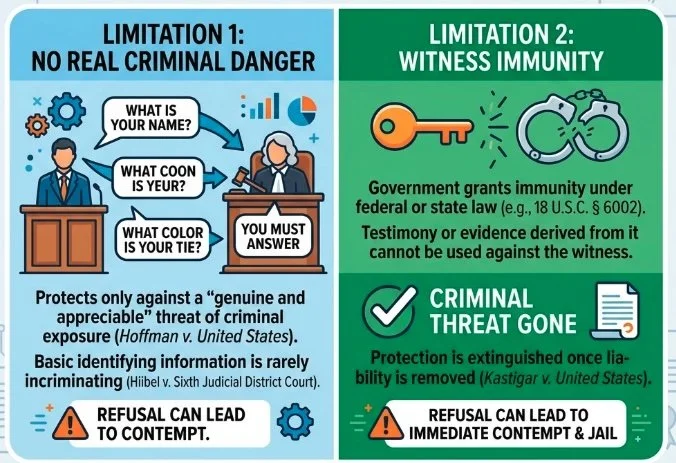
The U.S. Constitution and Article 2, Section 21 of the Oklahoma Constitution protect individuals from being compelled to give self-incriminating testimony. In the landmark case Hoffman v. United States (1951), the U.S. Supreme Court established that for the privilege to apply, the danger of criminal prosecution must be real and appreciable, not remote or speculative.
When Are You Not Protected?
Consequently, you cannot "plead the Fifth" to innocuous questions that carry no criminal penalties. If an Oklahoma prosecutor asks, "What color is your tie?" or "What is your name?" during a court proceeding, you are legally required to answer. In Hiibel v. Sixth Judicial District Court of Nevada (2004), the Supreme Court confirmed that stating your identity rarely poses a legitimate danger of incrimination. Because answering basic biographical or environmental questions carries zero criminal liability, refusing to answer will result in an Oklahoma judge holding you in contempt of court.
What If You Have Immunity?
The boundaries of this constitutional right become even narrower when the issue of witness immunity arises. Under federal law (18 U.S.C. § 6002) and Oklahoma law (specifically Article 2, Section 27 of the Oklahoma Constitution), the state has the authority to grant a witness immunity to compel their testimony. When a prosecutor grants use and derivative-use immunity, the government guarantees that neither your testimony nor any evidence derived from it can be used against you in a future criminal case.
Risking Contempt
Once immunity is granted, the threat of criminal liability completely vanishes. The Supreme Court affirmed in Kastigar v. United States (1972) that because immunity eliminates the risk of prosecution, it fully satisfies the constitutional protections of the Fifth Amendment. With the legal danger gone, you can no longer avail yourself of the privilege. If a witness continues to remain silent after being granted immunity, they face immediate incarceration for civil or criminal contempt.
Conclusion
If you are navigating the complexities of the justice system in Green Country, understanding the exact limits of your constitutional protections is vital. The Fifth Amendment is a powerful shield against government overreach, but it only protects you from self-incrimination—not from the basic obligations of being a witness.
By Brian Boeheim | Boeheim Freeman Law – Criminal Defense Division
Tulsa, Oklahoma - 918-884-7791 - onyourworstday.com