
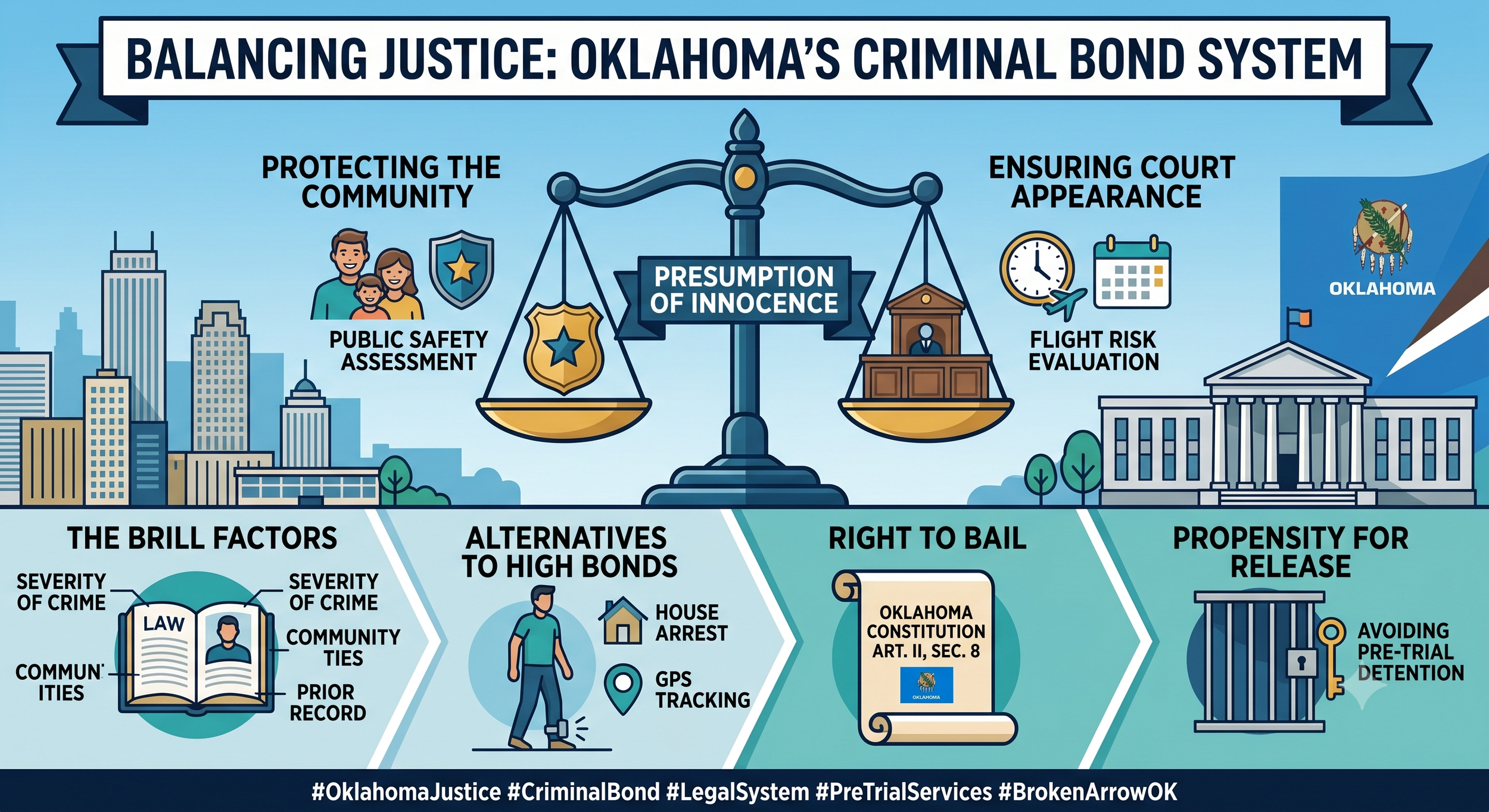
Mechanism of Setting Bond
In the Oklahoma criminal justice system, the mechanism of setting bail is a delicate constitutional balancing act. At its core, the pre-trial bond system must balance two competing mandates: protecting public safety and ensuring that a defendant—who remains legally presumed innocent—returns to answer the charges in court. By law, bail is designed solely as a tool to guarantee court appearances, never as a mechanism for pre-trial punishment.
Brill Factors
To navigate this balance, Tulsa Oklahoma courts heavily rely on a landmark judicial precedent established in the 1998 case Brill v. Gurich. A "Brill hearing" provides a formal framework where judges evaluate specific statutory guidelines rather than relying blindly on a rigid, pre-set county bond schedule. The Brill factors require the court to analyze the individual characteristics of both the offense and the offender. These factors include the seriousness of the crime and its potential sentence, the strength of the state's evidence, the defendant’s criminal and past bail history, and deep-rooted community ties—such as employment status, financial resources, length of residence, and the presence of family or community character references.
Mitigating Wealth-Based Detention
When a traditional cash or surety bond is set excessively high, it can inadvertently result in wealth-based detention, keeping low-income defendants incarcerated while they await trial. To mitigate this, Oklahoma jurisdictions increasingly utilize less restrictive alternatives to high monetary bonds. These include "Personal Recognizance" (P.R.) bonds, conditional releases, house arrest, and electronic monitoring via GPS ankle bracelets. These alternatives offer an effective middle ground: they alleviate jail overcrowding, allow individuals to maintain employment and prepare their legal defense, and strictly monitor movement to ensure public safety and court compliance without imposing a prohibitive financial barrier.
Fundamental Right to Bond
Finally, Oklahoma jurisprudence maintains a powerful propensity not to hold defendants entirely without bond. Under Article II, Section 8 of the Oklahoma Constitution, all accused persons have a fundamental right to bail, with very narrow, explicit exceptions. A judge may only deny bail entirely for capital crimes, certain violent offenses, or cases where the maximum possible penalty is life imprisonment, and even then, only if "the proof of guilt is evident, or the presumption thereof is great." Unless the state can conclusively demonstrate that no set of conditions can reasonably guarantee community safety or prevent flight, pre-trial release remains the constitutional standard, safeguarding the baseline tenet that an individual is innocent until proven guilty.
Author: Brian J. Boeheim
Boeheim Freeman Law - Criminal Defense Lawyers - Tulsa, Oklahoma - 918-884-7791