
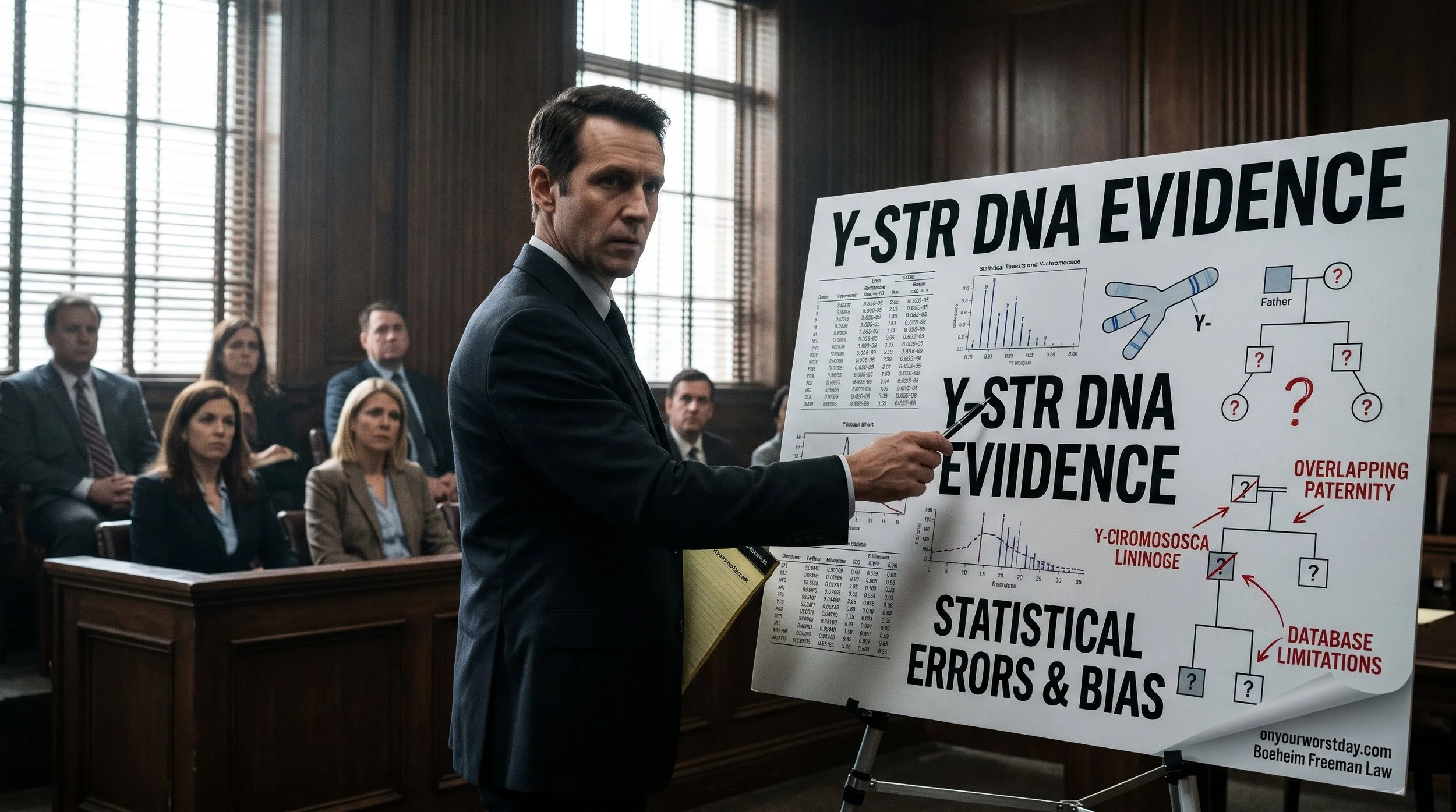
Why Y-STR DNA Testimony Can Mislead Juries
When prosecutors rely on Y-STR DNA testing to secure a conviction in sexual assault or mixed-DNA cases, scientific testimony often sounds airtight to a jury. However, Y-STR analysis works very differently from standard autosomal DNA testing, which combines genetic markers from both parents to calculate astronomical odds of a unique match.
Instead, the Y chromosome passes down virtually unchanged from father to son. All markers on the Y chromosome are inherited together as a single linked block called a haplotype. Because every male in a paternal lineage—fathers, brothers, uncles, and distant cousins—shares the exact same Y-STR profile, forensic lab technicians cannot use standard probability formulas to identify a single individual.
How Are Y-STR Haplotype Databases Statistically Inaccurate?
To estimate how common a male suspect's DNA profile might be, forensic analysts rely on the "counting method," checking how often a specific haplotype appears in a reference database. This approach introduces several major statistical flaws into criminal trials:
Limited Sample Sizes: Reference databases represent only a tiny fraction of the male population. When a profile is absent from a database of just a few thousand men, analysts apply mathematical adjustments—such as confidence intervals—to estimate its rarity.
Confusion Over Individual Identity: Jurors frequently mistake these database estimates for proof of a unique match, overlooking that hundreds or thousands of innocent male relatives share the exact same genetic profile.
Ignoring Local Population Clustering: National databases fail to account for regional genetics. Within a tight-knit local or Oklahoma community, a specific paternal haplotype may be far more common than broad national figures suggest.
Why Is Racial Stratification in Y-STR Databases Prejudicial?
Equally troubling is how forensic haplotype databases are stratified by race. On the witness stand, lab technicians routinely present match frequencies broken down into broad racial and ethnic categories, such as Caucasian, African American, Hispanic, and Asian. Introducing race-based DNA statistics creates unfair prejudice in the courtroom:
Priming Implicit Bias: Reciting racial categories alongside crime scene evidence subtly links the defendant’s race to the crime in the minds of jurors.
Artificially Inflated Rarity: Broad racial groupings mask complex genetic substructure and regional diversity. This often makes a minority defendant’s haplotype appear artificially rare—and far more incriminating—than it actually is.
Without a skilled criminal defense attorney to cross-examine the state's forensic experts and expose these database flaws, misleading statistical testimony can easily result in a wrongful conviction.
Facing Criminal Charges in Tulsa, Oklahoma?
If you or a loved one are facing criminal charges involving DNA or forensic evidence in Tulsa or surrounding Oklahoma communities, you need a defense team that knows how to expose scientific and statistical flaws in the prosecution's case.
Contact Boeheim Freeman Law - Criminal Defense Attorneys in Tulsa, Oklahoma. We aggressively challenge unreliable forensic testimony to protect your rights and your freedom.
📞 Call us at 918-884-7791 🌐 Visit us online at onyourworstday.com