
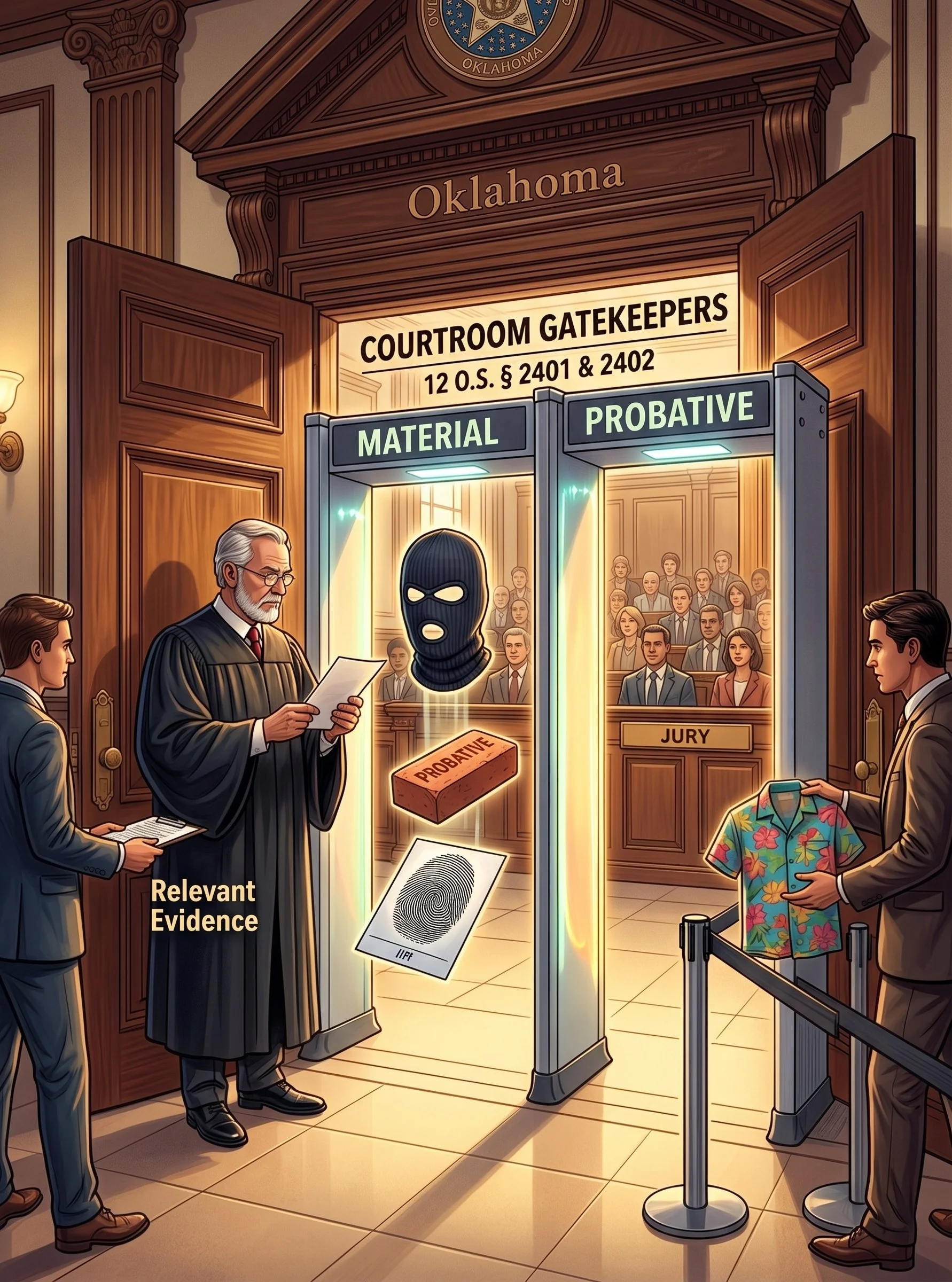
The Courtroom Gatekeepers: How Oklahoma Decides What Evidence Jurors Can See
In a criminal trial, someone’s freedom is on the line. When a prosecutor tries to convict a defendant, or a defense attorney fights to clear their client’s name, they cannot simply walk into an Oklahoma courtroom and say whatever they want.
Under Oklahoma law—specifically statutes 12 O.S. § 2401 and § 2402—the court relies on strict rules that act like security guards at the door. Rule 2401 defines what evidence is "relevant," while Rule 2402 lays down the law: if evidence is not relevant, it stays out. These rules protect jurors from getting distracted by pointless drama so they can focus on what actually happened.
To get past the courtroom door, every piece of evidence must pass a two-part test: it must be material and probative.
1. Material: Does the fact actually matter to the crime?
A fact is "material" if it connects directly to the crime charged, the defendant’s defenses, or whether a witness is telling the truth.
Imagine a defendant is on trial for robbing a convenience store. The color of the shirt the suspect wore to breakfast three weeks earlier is totally immaterial—it has nothing to do with the case. However, evidence showing the defendant owned the exact black ski mask dropped outside the store is material. An alibi proving the suspect was fifty miles away when the alarm went off is also material. These facts matter because they directly determine guilt or innocence.
2. Probative: Does the clue move the needle?
Evidence is "probative" if it has any tendency to make a fact more or less likely to be true.
Oklahoma courts set this bar very low. Evidence does not have to be a flashy "smoking gun" or instantly solve the mystery on its own. Instead, think of building a brick wall. A single brick does not make an entire wall, but every brick helps construct it. Finding the defendant’s fingerprints on a broken window does not prove all by itself that they stole anything. But it is a solid brick that proves they touched the window, making the state's case more probable.
Connecting the Clues: Circumstantial Evidence
Most criminal cases rely heavily on "circumstantial evidence"—indirect clues where jurors must use common sense to connect the dots.
If a witness hears a gunshot and seconds later sees the defendant running down an alley, that is circumstantial evidence. The witness did not see the trigger pulled, but the jury can reasonably infer what occurred. Oklahoma law treats circumstantial clues just as seriously as direct eyewitness testimony. A chain of several small clues can form a wall of proof that is impossible to knock down.
Laying the Foundation
Lawyers cannot simply toss a weapon or security video in front of the jury. Before introducing evidence, an attorney must "lay a foundation." They do this by having a witness explain what the item is and prove it was properly collected from the crime scene. This testimony builds a bridge connecting the item to the crime. If the lawyer fails to build that bridge, the judge will block the evidence from the trial.
Authored by: Brian J. Boeheim, Managing Partner
Boeheim Freeman Law – Criminal Defense Attorney – Tulsa, Oklahoma – 918-884-7791